


Your CEO just pinged you on Slack. The message is clear: “We’re behind on AI search. Everyone’s doing it. We need to move fast.”
Sound familiar?
Here’s what nobody’s telling you: the AI search revolution is losing to the search engine that everyone forgot exists.
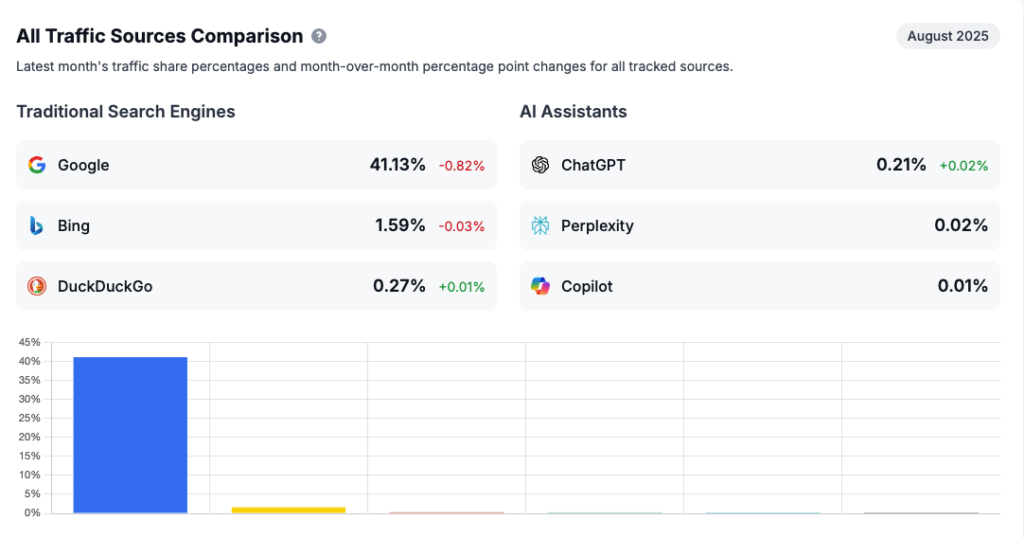
Fresh data from Ahrefs (chatgpt-vs-google.com) tracking 51,303 websites shows the brutal reality:
- Google: 41.13% of referral traffic
- Bing: 1.59%
- ChatGPT: 0.21%
- Perplexity: 0.02%
Read that again. ChatGPT, the poster child of AI search disruption,drives 8x less traffic than Bing.
Bing. The search engine people use by accident. The default nobody asked for. The platform where SEO careers go to die.
If your revolutionary traffic source can’t beat the search equivalent of a participation trophy, maybe it’s time to question the revolution.
The Numbers Don’t Lie (But Consultants Do)
I’ve been tracking search traffic for fifteen years. Every new channel follows the same playbook:
- Early wins get amplified into universal truths
- Consultants package those wins into premium frameworks
- Fear-driven adoption spreads through leadership teams
- Reality eventually shows up with a calculator
We’re deep in stage 3 right now. The AI search consulting industry is worth millions. The actual traffic? 0.23% combined market share.
That’s not disruption. That’s a rounding error with a marketing budget.
Meanwhile, Google’s “dying” monopoly still controls 41% of discovery. That’s not decline, that’s dominance with a different scoreboard.
Industry Blind Spots Are Expensive
The AI traffic story changes by vertical. News and finance see meaningful ChatGPT referrals because users want quick summaries and conversational responses.
But if you’re in SaaS, B2B services, or enterprise sales? AI search traffic is invisible in your analytics. It won’t move your pipeline. It won’t hit your board metrics. It won’t fund your headcount.
The problem isn’t that AI search doesn’t work. The problem is assuming it works everywhere, for everyone, right now.
Most companies chasing AI traffic are optimizing for an audience that doesn’t exist yet.
Smart Testing vs. Expensive Theater
I’m not anti-AI. I use it daily for content workflows, data analysis, and funnel optimization. Testing early is how you build resilience.
But there’s a difference between strategic experimentation and performative pivoting.
Strategic moves:
- Test conversational content formats for eventual AI pickup
- Structure your data so AI can cite you properly when volume arrives
- Monitor AI referral patterns in your specific vertical
Theater moves:
- Reorganize your content strategy around 0.21% of traffic
- Hire dedicated “AI SEO specialists” before proving ROI
- Deprioritize Google optimization to chase microscopic AI traffic
I’ve watched teams burn six months and $200K chasing AI search optimization before realizing their traffic didn’t move. The pattern is predictable: broken attribution, confused messaging, exhausted teams trying to scale systems built for problems that don’t exist yet.
Reality-Based Growth Strategy
Here’s what the data actually tells us:
Google isn’t dying, it’s consolidating. At 41% traffic share, it’s still the primary discovery engine for most industries. Optimizing for Google remains the highest-ROI search activity for 90% of businesses.
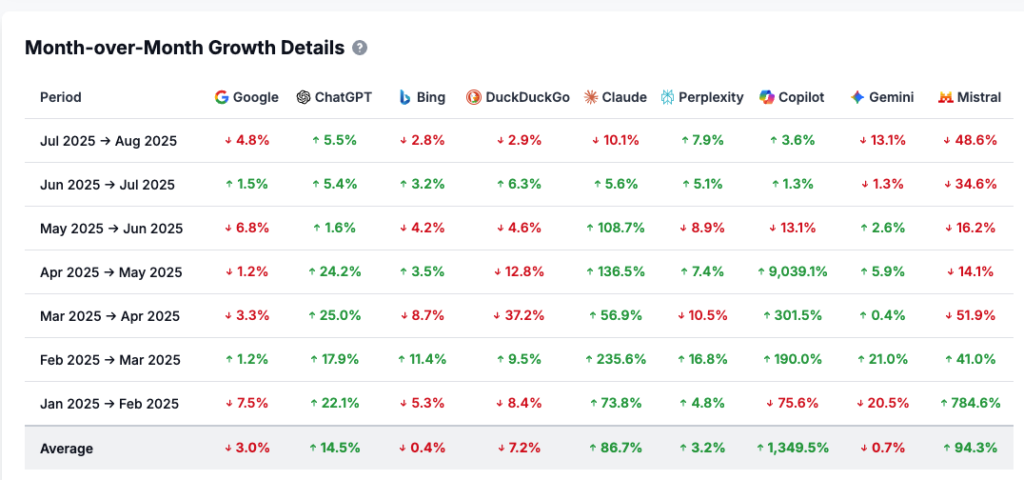
AI search is growing from zero. ChatGPT is up 5.5% month-over-month, Perplexity up 7.9%. But growth from zero is still close to zero.
Timing matters more than tactics. The companies that win in AI search won’t be the ones who started earliest, they’ll be the ones who scaled fastest when volume actually materializes.
Right now, AI search is a future opportunity, not a current strategy.
When ChatGPT traffic hits 2%, 5%, or 10% of total referrals, I’ll be first in line building systems to capture it. When it reaches Bing-level traffic, it’ll deserve Bing-level attention.
Until then, I’m optimizing for the 41% that actually exists, not the 0.21% that might.
The Bottom Line
Growth isn’t built on hype. It’s built on math.
The math says Google drives 195x more traffic than ChatGPT. The math says Bing-laughingstock Bing, is 8x bigger than the AI assistant everyone’s talking about.
When your “next big thing” can’t beat the search engine equivalent of a consolation prize, maybe it’s time to check your assumptions.
AI search will eventually matter. When it does, the data will be unmistakable. Until then, stop optimizing for tomorrow’s problems and start solving today’s traffic reality.
The revolution will be measured. This isn’t it.
Data source: Ahrefs analysis of 51,303 websites, January-August 2025. Verify the numbers at chatgpt-vs-google.com. The math doesn’t care about your AI strategy.