

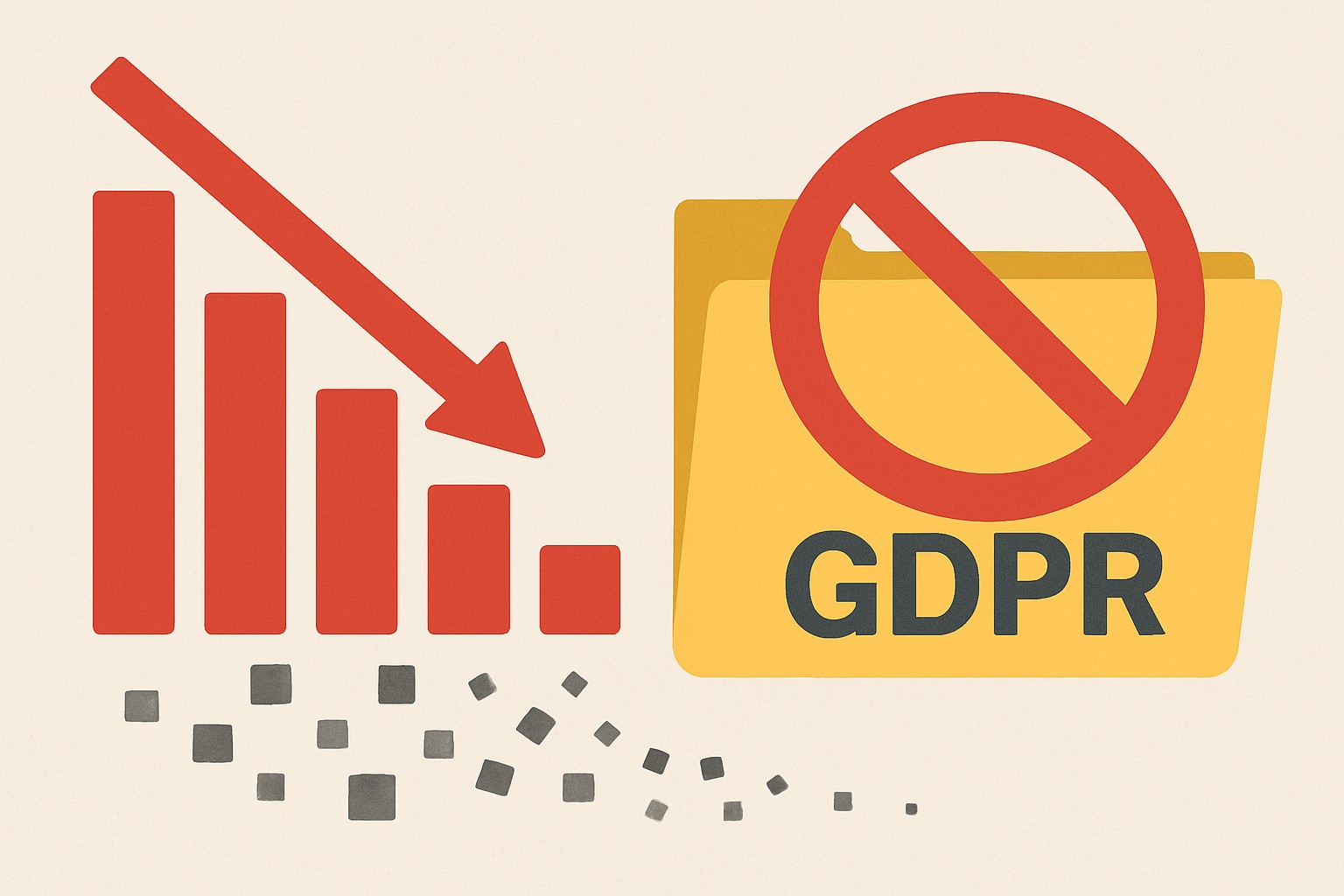
When your marketing data drops 90% but you’re still violating GDPR: A technical analysis of the compliance circus
The Numbers That Should Terrify Everyone
According to the CMS GDPR Enforcement Tracker Report 2024/2025, as of March 2025, a total of 2,245 GDPR fines have been recorded, amounting to €5.65 billion. The average fine across all countries stands at €2,360,409. Yet despite this massive enforcement reality, most companies are still getting it wrong, destroying their marketing data while remaining non-compliant.
The absurd situation we’re facing becomes clear when you look at the data loss. According to Matomo’s analysis from May 2024, “there are a lot of cases of observing 90-95% drop in metrics of users and sessions” after implementing Google Consent Mode v2. This isn’t a temporary adjustment period, it’s the new reality where marketing attribution has become effectively meaningless while companies still violate the very regulations they’re trying to comply with.
Sweden’s recent enforcement actions paint a clear picture of this failure. In July 2023, the Swedish Data Protection Authority issued a 12 million SEK fine against Tele2 and 300,000 SEK against CDON for Google Analytics violations. These weren’t fly-by-night operations, they had consent banners, they had compliance teams, they thought they were protected. They were wrong.
The Technical Reality Your Compliance Team Doesn’t Understand
The Pre-Consent Data Hemorrhage
The fundamental misunderstanding starts in the first 100 milliseconds of page load. When a browser loads your page, it immediately begins executing scripts and establishing connections. By the time your carefully designed consent banner appears at 500 milliseconds, multiple data points have already been transmitted to third-party servers. Every one of those pre-consent requests includes IP addresses (which GDPR explicitly defines as personal data), browser fingerprints that create unique identifiers, referrer URLs that enable behavioral tracking, and device information that contributes to fingerprinting.
Your compliance manager sees a cookie banner and declares victory. Meanwhile, Ireland alone has issued over €2.8 billion in GDPR fines according to Statista’s September 2024 data, with Luxembourg following at €746 million and France at €371.82 million. Most of these companies had consent banners too.
The geographic blindness in most implementations makes this worse. GDPR protects EU citizens globally, not just when they’re physically in the EU. That Italian executive accessing your site from Singapore remains protected under GDPR, but your geo-IP targeting won’t show them a consent banner because they’re outside EU IP ranges. This creates a documented violation that’s trivially easy for regulators to discover and prosecute.
The Marketing Data Apocalypse: Real Numbers from the Field
GA4’s Consent Mode v2 Disaster
Google marketed Consent Mode v2 as the privacy-friendly solution that would save digital marketing. The reality has been catastrophic for data quality. According to Google’s own documentation, behavioral modeling, the feature that’s supposed to fill in the gaps, requires your property to collect at least 1,000 events per day with analytics_storage=’denied’ for at least 7 consecutive days, plus at least 1,000 daily users submitting events with analytics_storage=’granted’ for 7 of the previous 28 days. Most websites never reach these thresholds, leaving them with permanently degraded data that makes campaign optimization impossible.
The practical impact is devastating. Some reported that businesses using GA 360 “will see a drop in traffic that can’t be recovered,” while standard GA4 users below the modeling threshold face the same permanent data loss. This isn’t a configuration issue or a temporary problem, it’s the fundamental incompatibility between privacy regulations and modern analytics.
The Meta Pixel Liability Bomb
The Meta Pixel situation is even more precarious from a legal standpoint. Cookie Information reported in November 2024 that the Swedish Data Protection Authority issued a fine of 15 million Swedish kronor (approximately €1.34 million) for Meta Pixel violations. What makes this particularly significant is that the website operator, not Meta, was held liable for the GDPR compliance issues.
The scale of Meta-related fines tells a sobering story. According to Statista‘s September 2024 data, Meta received a €1.2 billion fine in May 2023 for violating laws on digital privacy through Facebook’s EU-U.S. data transfers, the largest GDPR fine ever issued. In January 2023, they received another €390 million for improperly requiring users to accept personalized adverts, and in September 2022, a €405 million fine for Instagram’s children’s privacy violations.
But here’s what should really concern marketers: it’s not just Meta getting fined. The Swedish authorities fined Avanza Bank approximately €1.3 million in 2024 for transferring customer data to Meta through incorrect Pixel settings. The bank had mistakenly activated Advanced Automatic Matching, causing personal data including social security numbers and bank account numbers to be transferred to Meta between November 2019 and June 2021. They thought they were using a standard marketing tool. They ended up with a seven-figure fine.
Why Compliance Teams Are Making Everything Worse
The Server-Side Shell Game
The server-side tracking movement represents one of the most expensive misunderstandings in digital marketing. Companies are investing thousands of euros monthly in server-side Google Tag Manager implementations, believing they’ve found a GDPR loophole. The logic seems sound on the surface: data goes to your EU server first, not directly to Google, therefore you’re compliant.
This fundamentally misunderstands how GDPR defines data transfers. When personal data enters your EU server and then forwards to Google’s U.S. infrastructure, you haven’t eliminated the transfer, you’ve just added an extra hop. The data still ends up under U.S. jurisdiction, still subject to FISA 702 surveillance, still violating the principles established in the Schrems II ruling. You’re essentially believing that money laundering becomes legal if you deposit the funds in your own account first.
The CMP False Security Blanket
The Consent Management Platform industry has grown into a multi-million euro business selling the illusion of compliance. These platforms generate impressive dashboards showing consent rates, vendor management, and audit logs. What they carefully avoid highlighting is that network requests to tracking domains fire before their JavaScript even loads, that browser fingerprinting happens regardless of consent choices, and that rejecting cookies doesn’t prevent the initial data transfer that already occurred.
According to DLA Piper‘s GDPR and Data Breach Survey from January 2024, there were an average of 335 breach notifications per day from January 28, 2023 to January 27, 2024. Many of these breaches involved companies with expensive CMPs and “comprehensive” privacy programs. The tools aren’t broken, the entire approach is fundamentally flawed.
The Enforcement Reality Check
Who’s Getting Hit and Why
The CMS GDPR Enforcement Tracker Report reveals that the highest average fines target the “Media, Telecoms and Broadcasting” sectors, but no industry is safe. Spain has shown the most enforcement activity with 932 published fines, while Italy, Romania and Germany have issued between 86 and 400 fines each. The variation isn’t about some countries being stricter, it’s about different publication thresholds and enforcement priorities.
What’s particularly telling is the evolution of enforcement. DLA Piper’s 2024 survey notes that supervisory authorities issued EUR 1.78 billion in fines from January 2023 to January 2024, a 14% increase over the previous year. The era of warnings and educational enforcement is over. Regulators now have sophisticated technical capabilities and are actively looking for the kinds of pre-consent data transfers that virtually every website exhibits.
The Austrian Domino Effect
Austria’s rulings have created a cascade effect across Europe. After declaring Google Analytics illegal under GDPR, they turned their attention to Meta Pixel. According to the article, the Austrian DPA explicitly stated that companies needing to comply with GDPR should avoid using Meta Pixel entirely. This wasn’t a configuration issue or an implementation problem, the tool itself was deemed incompatible with GDPR requirements.
France, Italy, and the Netherlands have followed with similar rulings. The technical reality that data transfers to U.S. companies subject to surveillance laws violate GDPR is finally being universally acknowledged. This isn’t one country being strict, it’s the legal system catching up to technical reality.
What Actually Works (Spoiler: Not Much)
For Compliance: The Uncomfortable Truth
Real GDPR compliance, as interpreted by recent enforcement actions, means accepting dramatic changes to digital marketing. No tracking can begin until explicit consent is obtained, which immediately eliminates data from approximately 70% of users according to industry consent rates. U.S.-based tools like GA4 and Meta Pixel must be completely abandoned, not just configured differently. All infrastructure must be EU-hosted with actual data anonymization, not just IP truncation that regulators have repeatedly deemed insufficient. Users must be asked to re-consent annually, creating an ongoing drain on your consented user base.
This isn’t hyperbole, it’s the logical conclusion of current enforcement trends. Modern digital marketing as practiced today cannot exist under strict GDPR compliance.
For Marketing: Accepting the New Reality
For those who insist on using GA4 and Meta (and let’s be honest, that’s nearly everyone), the path forward requires acknowledging reality. Legal teams must document their risk acceptance in writing, explicitly acknowledging they understand the technical violations and potential fines calculated as a percentage of global turnover. Marketing teams must shift to probabilistic attribution methods like Media Mix Modeling, incrementality testing, and geo experiments, accepting that true user-level ROI will never be knowable again.
The focus must shift to first-party data strategies built on explicit consent. Email marketing, customer data platforms, and direct relationships become more valuable than pixel-based tracking. This isn’t just a compliance requirement, it’s becoming a competitive necessity as third-party data quality continues to degrade.
For Sanity: The Grey Zone Nobody Admits To
The reality most companies won’t publicly acknowledge is that they’re operating in a deliberate grey zone. They implement “good enough” consent mechanisms that they know don’t fully prevent pre-consent data transfers. They accept the massive data loss while hoping behavioral modeling eventually kicks in. They prepare documentation for eventual enforcement while hoping it doesn’t come their way.
This isn’t advice, it’s simply an observation of how the industry actually operates versus how it pretends to operate.
The Bottom Line
We’re witnessing the collision of incompatible systems. Marketing needs user-level data to function effectively. Privacy regulations demand that data not be collected without explicit consent. Technology platforms built their entire architectures on assumptions that are now illegal. And companies are stuck in the middle, hemorrhaging both data quality and legal liability.
According to the January 2025 CSO Online report, GDPR fines hit €1.2 billion in 2024 alone, with LinkedIn fined €310 million and Meta fined €251 million just in that year. The enforcement isn’t slowing down, it’s accelerating and becoming more technically sophisticated. Meanwhile, marketers are making decisions based on data that Matomo describes as potentially facing “90-95% drop in metrics.”
Your consent banner is theater that doesn’t prevent the actual violations. Your analytics data is so degraded it’s essentially fictional. Your compliance is an expensive illusion. And your marketing ROI is unknowable with any precision.
This is digital marketing in 2025: caught between impossible requirements, degraded capabilities, and accelerating enforcement. Until regulators, platforms, and businesses have an honest conversation about what’s technically possible versus legally required, we’re stuck in this expensive, ineffective circus where everyone loses, except the lawyers and the CMP vendors.
About the Author: A marketer and technical consultant watching companies burn millions on compliance theater while destroying their marketing effectiveness and still remaining vulnerable to fines. Currently explaining to executives why their dream of “compliant full tracking” is physically impossible while building attribution models on the scraps of data that survive consent mechanisms.