

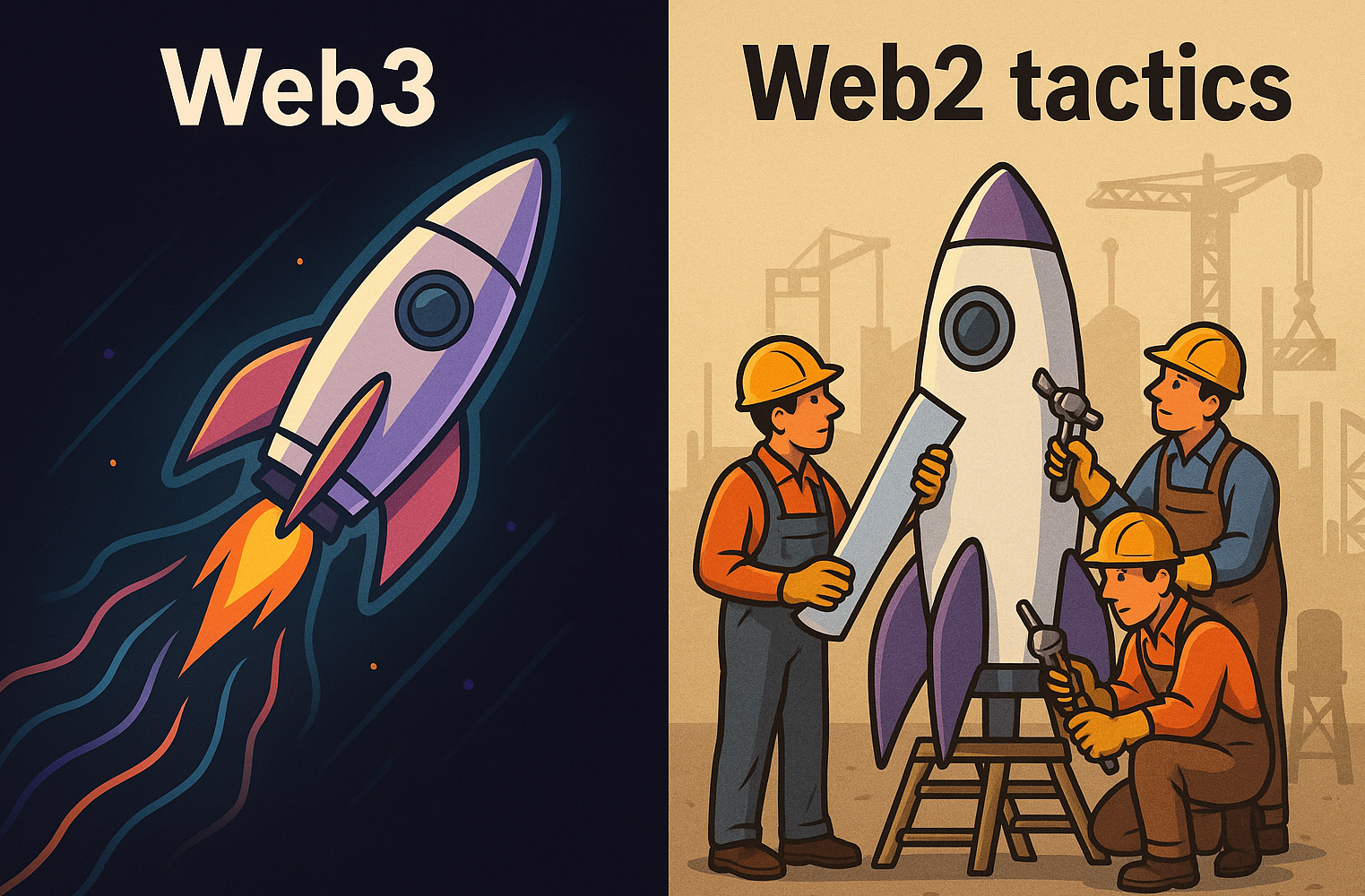
Why foundational growth work gets sidelined, and what that reveals about organizational maturity in a fast-moving industry.
Web3 Wants Growth, But Craves Speed
Web3 teams hire me to solve a growth problem they can’t name: they want predictable user acquisition, but they’ve built organizations that can only execute campaigns.
I came to crypto after a decade building growth systems across SaaS, B2B tech, and competitive digital markets. What I found was an industry rediscovering growth principles that established markets learned years ago, but with the energy and innovation that made me fall in love with this space. Now I work with Web3 companies and protocols, bringing systematic growth thinking to teams that need it most.
The gap isn’t technical. It’s organizational.
And nowhere is this clearer than in how Web3 treats SEO, not as a channel, but as a test of whether your company can build systems that compound.
The Real Problem: Asking Teams to Run When They Can’t Crawl
Some time ago, I had a conversation that comes up all too often in Web3. A VP of Growth asked me: “Can you prove anyone actually comes from organic search? Leadership wants to see the impact.”
At that point, I had spent months trying to implement foundational SEO work, basic metadata, page structure improvements, sitemap indexing, and documentation discoverability. The docs lived in a React app, and while technically indexable, they weren’t being surfaced due to lack of proper configuration. Despite clear gaps, engineering deprioritized all technical SEO tickets for months.
And yet, now leadership wanted data to prove organic growth.
This is what I mean by asking teams to run when they can’t crawl.
In competitive SaaS markets, this conversation doesn’t happen; SEO isn’t debated, it’s operationalized. The companies that win know that discoverability is compounding. The ones that don’t get left behind.
Web3 still hasn’t caught up. And the culture shows it. If an engineer with zero SEO knowledge can block strategy on opinion alone, it’s not just a gap, it’s a signal. Long-term growth isn’t culturally supported.
Why Web3 Resists Growth Infrastructure
Web3 operates in a perpetual state of urgency. Everything is a sprint: funding cycles, token launches, partnership announcements, market moves. This creates cultures where:
- Quarterly planning is considered “long-term”
- Anything that doesn’t show immediate metrics gets deprioritized
- Engineering roadmaps have no room for growth infrastructure
- Marketing is expected to generate demand without the tools to capture it
I’ve seen this pattern across dozens of teams. Marketing requests basic SEO implementations, updated meta tags, structured data, canonical URLs, and engineering treats it like a nice-to-have. Meanwhile, the same engineering team will spend months on features that five users requested in Discord.
The result? Marketing is held accountable for growth metrics they can’t systematically influence.
In traditional B2B, this would be career suicide for leadership. In Web3, it’s Tuesday.

What Growth Architecture Actually Means
When I tell Web3 teams I’m a growth architect, they often think I mean “senior marketer.” They don’t understand the distinction.
A marketer executes campaigns. An architect builds systems that work without them.
Growth architecture means:
- Your product is discoverable when you’re not promoting it
- Your funnel converts visitors into users systematically, not sporadically
- Your content strategy compounds over time instead of requiring constant creation
- Your technical infrastructure supports growth goals, not just product goals
- Your attribution systems show what actually drives sustainable acquisition
Most Web3 companies have none of this. They have campaigns, hype cycles, and community engagement. But when you ask “How do new users find you when you’re not launching something?” the answer is usually silence.
The SEO Litmus Test for Organizational Maturity
SEO reveals everything about how a company thinks about growth.
Mature organizations understand that SEO is infrastructure. Like security, like monitoring, like backups, it’s unglamorous work that prevents catastrophic failure later.
Immature organizations treat SEO as a channel. Something marketing “does” to get more traffic, separate from product, engineering, or business strategy.
Here’s how this plays out in practice:
Technical SEO Requests Get Deprioritized
I’ve been told that updating product page metadata is “not engineering’s job.” Meanwhile, the same team will spend an hour debating why they can’t prioritize it, then immediately ship a UI tweak with no measurable impact. Discoverability work doesn’t just get ignored; it gets talked out of existence.
Leadership Wants Proof That Doesn’t Exist Yet
“Show me the organic traffic” from companies whose sites aren’t optimized for organic discovery. It’s like asking for proof that a foundation works on a building you haven’t built yet.
Growth and Product Work in Silos
Product teams ship features without considering discoverability. Growth teams are expected to drive adoption for products that can’t be found. Nobody thinks about the customer journey from search to activation.
Attribution Fails Because Tracking Is an Afterthought
The problem isn’t the lack of data, it’s the lack of structure to capture it. Teams ship core pages without even basic tracking in place, then wonder where users come from. They check active user counts and build growth strategies around feelings, not funnels. Attribution isn’t broken, it is not too often instrumented.
This isn’t a Web3 problem; it’s a maturity problem that Web3 hasn’t solved yet.
What I Learned from Highly Competitive SaaS Markets
Before Web3, I spent years in highly competitive SaaS and B2B markets, hosting platforms, web infrastructure, and digital services. Markets where every user matters because competitors are fighting for the same customers, and growth has to be systematic because there’s no room for waste.
In those environments, you learn fast:
Campaigns get you meetings. Systems get you markets.
Here’s what that means in practice:
- Everything Gets Tested and Measured
Not just ads and emails, everything: page layouts, documentation structure, onboarding flows, feature positioning. You test because guessing costs too much when competitors don’t guess. - Technical SEO Is Non-Negotiable
Because when someone searches for your category, you either show up or your competitor does. There’s no neutral ground. - Attribution Is Rigorous
Because if you can’t prove what drives growth, you can’t scale what works or kill what doesn’t. Multi-touch attribution isn’t a nice-to-have, it’s survival. - Growth and Product Are Integrated
Because the best product in the world is worthless if users can’t discover, understand, or adopt it. Growth considerations influence product decisions from day one.
Long-Term Compounds Short-Term
Because building sustainable advantages takes time, and companies that only think quarterly get overtaken by companies that think in years.
Web3 teams often act like they invented growth from scratch. But these principles aren’t new, they’re just new to Web3.
The Organizational Fix: Systems Before Campaigns
When Web3 teams ask me to “help with growth,” they usually mean “run more campaigns.” But campaigns without systems just burn money and attention.
Real growth architecture starts with organizational changes:
1. Engineering Owns Growth Infrastructure
Technical SEO, performance optimization, analytics implementation, and A/B testing infrastructure become engineering responsibilities, not marketing requests.
2. Attribution Gets Built Into Everything
From the beginning. Not as an afterthought when leadership asks “what’s working?”
3. Product and Growth Plan Together
Feature releases include discoverability strategy. Documentation updates happen simultaneously with product updates. Growth considerations influence the product roadmap.
4. Long-Term Metrics Get Equal Weight
Monthly active users matter as much as weekly Discord activity. Organic search growth gets the same attention as social engagement.
5. Leadership Understands Growth Timelines
SEO takes months to show impact. Paid campaigns need weeks to optimize. Content strategies compound over quarters, not days.
Most Web3 teams aren’t ready for this conversation. They want the results of systematic growth without the organizational commitment to build systems.
Why I Only Work with Teams Ready to Build Infrastructure
I don’t do growth consulting anymore. I do growth architecture.
That means I only work with teams that understand:
- Growth infrastructure takes time to build but compounds indefinitely
- Technical changes are growth changes, they’re not separate workstreams
- Attribution complexity is the price of growth sophistication
- Systematic testing beats intuitive campaigns
- Long-term competitive advantage comes from systems competitors can’t easily copy
If a Web3 team isn’t ready for that conversation, they’re not ready for sustainable growth.
They’re ready for another campaign that will work until it doesn’t.
The Web3 Growth Maturity Gap
Web3 will eventually learn what competitive markets learned: systematic, infrastructure-based growth beats campaign-driven growth every time.
The companies that learn this first will compound user acquisition while their competitors burn attention.
The companies that don’t will keep rediscovering why consistent growth is hard, and wondering why their competitors seem to grow effortlessly.
I work with Web3 companies because I believe this technology changes everything, but only if the right teams can build sustainable user bases. That means bringing proven growth systems to an industry I’m passionate about, helping teams skip the learning curve by building engines that make growth systematic, predictable, and sustainable.
Because in five years, the Web3 companies that matter won’t be the ones that tweeted the most.
They’ll be the ones that built growth engines that worked without them.
